
Conversation with Ahmad Ashour: "Reconstruction begins with the capacity to recreate meaning".
Originally from Gaza, Palestine, Ahmad Ashour is a researcher and cultural actor. His work lies at the intersection of cultural action, education, and humanitarian response in crisis contexts, with a particular focus on the role of cultural institutions during periods of destruction and disruption.
For several years, he directed the Tamer Institute for Community Education in Gaza, where he worked to promote reading, education, and cultural life among children and young people. He also held coordination roles within the French humanitarian organization ACTED. Currently hosted in France through the PAUSE program, he is pursuing his research at the University of Tours within the INTRU laboratory, while studying cultural policy at Sciences Po Grenoble.
How do your works contribute to a form of reconstruction?
My research focuses on cultural dynamics in contexts of war and post-war, with a particular focus on Gaza. On one hand, I examine cultural life prior to the war, notably the role of libraries, cultural centers, and local initiatives in shaping practices around reading, creation, and critical thinking. On the other, I analyze current transformations within these dynamics, studying both the emergence of a Gazan artistic movement in Europe and the situation of those trapped in Gaza, who face a form of internal exile.
By drawing on tools from post-war philosophy, I also analyze questions of identity, institutional discourse, and how forms of censorship emerge and take shape, particularly within children's literature.
This work contributes to a cultural, intellectual, and institutional reconstruction. It allows me to offer analytical tools to deconstruct the narratives surrounding Gaza and to feed into reflections on cultural policies—drawing inspiration from existing models, particularly in France—to envision, over the long term, the reconstruction of cultural institutions and spaces.
How do you define reconstruction?
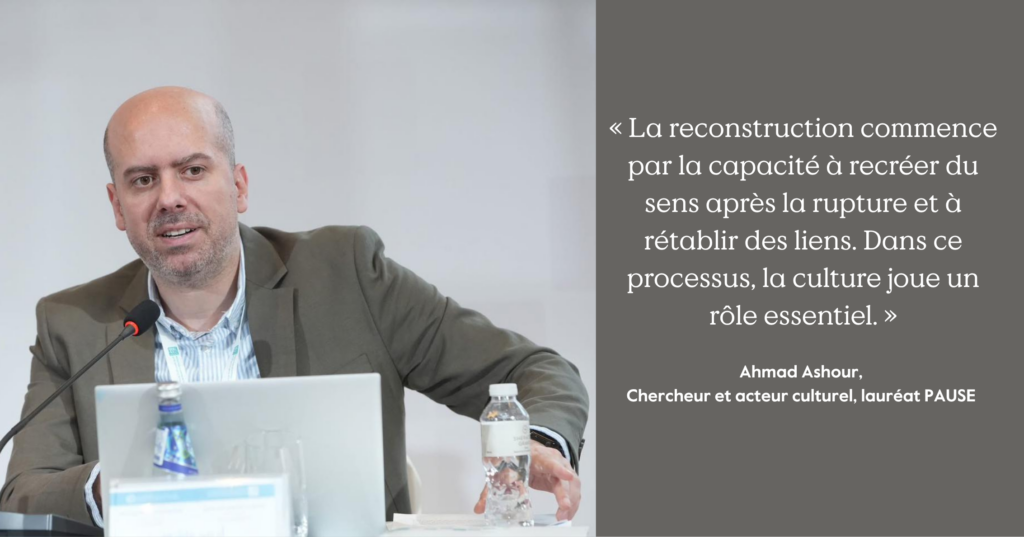
For me, reconstruction begins with the ability to recreate meaning after a disruption and to restore connections. Culture plays an essential role in this process: it maintains continuity while opening new avenues for thought and creation.
In my experience, it is often simple spaces—like libraries or community centers—that reignite these dynamics. I view reconstruction as both a collective endeavor and a personal commitment.
At my scale, I hope to contribute to rebuilding a democratic and cultural life in Gaza through the research, collaborations, and exchanges I engage in today. I believe it is crucial to keep speaking about Gaza and to support the artists, institutions, and communities keeping this cultural life alive. True reconstruction cannot happen without sustained attention, commitment, and a genuine pursuit of justice.
Programme PAUSE
Collège de France
11 place Marcelin Berthelot
75005, Paris

© Programme Pause - Tous droits réservés 2023